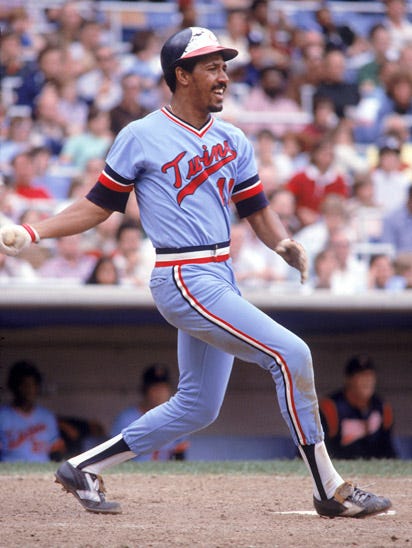
Remembering Lyman Bostock

November 22nd would have been Lyman Bostock’s 72nd birthday. Being too young to have seen him play baseball with the Twins and Angels, there wasn’t much I knew about Lyman. I knew he was a rising baseball star, whose life and career was cut short in the most tragic way. But after reading and learning more about him, I realized that Lyman Bostock was more than just a rising baseball star. Lyman Bostock was a great human being.
In his first full season with the Twins in 1976, Bostock broke out as a two-way threat. Showing a fine glove in centerfield and a stellar bat at the plate, Bostock hit .323 finishing fourth in the American League batting race. Bostock would finish second in the AL in 1977, hitting .336. The guy who finished first? Bostock’s Twins teammate and baseball legend Rod Carew, who finished the season at .388.
During the 1970’s, the Twins had one of the lowest payrolls in baseball. Owner Calvin Griffith was notoriously cheap and avoided paying his best players by trading them away or letting them go in free agency. Bostock became a free agent in 1978. Griffith could not come close to the 6 year, $2.3 million contract offered by the Angels and Bostock left for California as one of the most touted young stars.
Immediately after signing with the Angels, Bostock donated $10,000 to a church in his hometown of Birmingham, Alabama. The money was used to rebuild the church’s Sunday school.
Bostock’s bat went cold to start the 1978 season. In April, his batting average was well below the Mendoza Line. Believing he wasn’t doing his job and that he had not earned his monthly salary, Bostock met with Angels general manager Buzzie Bavasi. Bostock wanted to return the money he made in April to the Angels, but Bavasi would not accept it. Bostock announced he would donate it to charity and received letters from thousands asking for his donation. He read every last letter and donated his April salary to the charity he felt needed it the most.
The 1978 season would eventually turn around for Bostock. On Saturday September 23rd, Bostock got his average up to .296 in the second game of a weekend series against the White Sox in Chicago. It would be the final time he would play Major League Baseball.
Lyman Wesley Bostock Jr. was murdered at age 27 that night, by a man named Leonard Smith. Bostock had driven to Gary, Indiana to visit friends and family, which he always did when his team was in Chicago. Smith was sitting outside of Bostock’s friends house when he saw his wife, Barbara, drive away in a car with Bostock and two others.
Leonard and Barbara Smith were separated, but still married. Leonard, in a dangerous mental state, convinced himself that his wife and Bostock must have been having an affair. The truth was, Bostock had tutored Barbara in school when they were teenagers and the two had remained friends. They had not seen or talked to each other in several years leading up to that night.
One round was fired from a .410 shotgun into the backseat of the car Bostock was riding in. Leonard had followed the car to stoplight, where he committed the senseless act. Bostock was struck squarely in the right temple. Two hours later, he was dead.
A blooming baseball career was not the only thing lost that night in 1978. The life of a great man ended far too soon. His character not only showed in his charity donations. It showed in how he carried himself in every day life. Bostock was known to be always smiling, always laughing, and always looking on the bright side. The kind of person who, in his short life, made the world a better place.
Ken Brett, a teammate of Bostock’s with the Angels, delivered the eulogy at his friends funeral. “We called him Jibber Jabber because he enlivened every clubhouse scene, chasing tension, drawing laughter in the darkest hour of defeat,” Brett spoke. “When winning wasn’t in the plan, Lyman knew the sun would come up the next morning. There’s only one consolation: We’re all better persons for having him touch our lives.”